Enterprise AI Operations
How to Implement AI in Business Operations: The Tasks to Systems to Agents Framework
A practical framework for turning scattered AI experiments into structured operational systems that enterprise teams can trust, measure, and scale.
Primary topic
AI in business operations
Audience
Enterprise teams and decision-makers
Lens
Operational design before automation
Why AI Business Operations Initiatives Fail at the Operations Layer
How to implement AI in business operations is often treated as a tooling question.
Teams test platforms like ChatGPT, experiment with prompts, and encourage internal exploration. This creates activity, but it rarely leads to scalable results.
Research from McKinsey shows that many organizations remain in early or fragmented stages of AI adoption, with limited integration across core workflows.
Access to AI is no longer the limiting factor. The structure of work inside the organization determines whether AI creates meaningful value.
When processes are unclear or inconsistent, AI amplifies fragmentation instead of improving efficiency. Clear operations are the prerequisite for effective adoption.
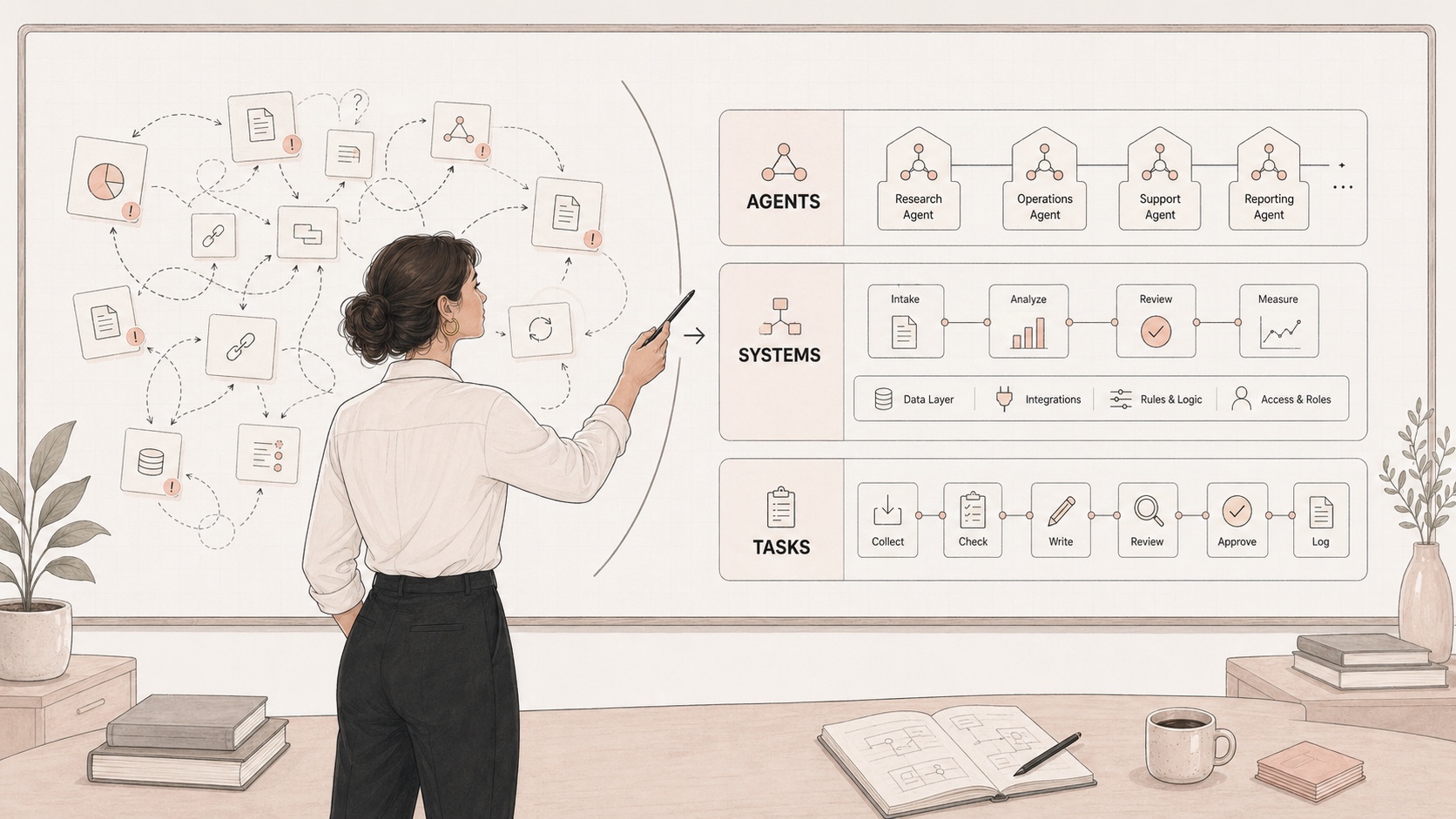
The Tasks to Systems to Agents AI Implementation Framework
Tasks: Define Repetitive Business Tasks Before Automating AI
Tasks are the individual actions performed across the organization.
Examples include:
- Pulling reports
- Updating CRM records
- Reviewing campaigns
- Approving budgets
In many companies, these tasks exist as habits rather than defined steps. Different people complete them in different ways, which introduces variability.
Without clarity at the task level, there is no stable foundation for automation.
Systems: Turn Business Tasks Into Repeatable AI Workflows
Systems organize tasks into repeatable workflows.
A system defines:
- Trigger conditions
- Required inputs
- Decision points
- Expected outputs
At this stage, work becomes structured and predictable. It can be measured, improved, and documented.
Most organizations treat documentation as the end goal. In practice, documentation only becomes valuable when it leads to consistent execution.
Systems create that consistency.
Agents: Deploy AI Agents Inside Structured Business Systems
Agents execute or support parts of a system.
Once workflows are clearly defined, it becomes possible to assign execution to AI in a controlled way.
Examples include:
- Generating reports from structured data
- Monitoring performance and flagging anomalies
- Drafting outputs based on predefined rules
At this level, AI integrates directly into operations instead of sitting outside of them.
Why AI Implementation in Business Operations Breaks Down
Many organizations attempt to move directly from tasks to agents without structuring systems first.
The result is predictable:
- Outputs vary in quality
- Workflows become difficult to manage
- Teams lose confidence in AI-generated work
Gartner research consistently shows that automation initiatives fail when underlying processes are not clearly defined or standardized.
Without systems, AI operates without clear constraints. This leads to inconsistency and reduced adoption.
The missing layer is almost always process design.
How AI Changes Roles Inside AI-Driven Organizations
Employees: Shift From Task Execution to Judgment and Exception Handling
AI adoption changes how work is performed across the organization. Roles shift toward higher-leverage activities.
Employees contribute context, judgment, and exception handling.
Their focus moves toward:
- Improving inputs
- Handling edge cases
- Interpreting outputs
Execution-heavy tasks decrease.
Middle Management: Own AI Workflow Design and Oversight
Middle managers become responsible for workflow design and oversight.
Their role includes:
- Structuring systems
- Coordinating multiple agents
- Reviewing outputs at a higher level
They operate at the intersection of business logic and execution.
Leadership: Prioritize Where AI Should Transform Operations
Leadership defines which parts of the organization should be systemized.
This includes:
- Identifying inefficiencies
- Prioritizing transformation areas
- Ensuring alignment across teams
Strategic clarity determines where AI creates the most impact.
Examples of AI in Business Operations Across Marketing, Sales Operations, and Finance
Marketing Operations
Sales Operations
Finance Operations
A Simpler Framework for AI in Business Operations
Implementing AI in business operations is fundamentally an exercise in operational design.
The focus shifts to:
- How work flows
- Where decisions are made
- Which steps require human judgment
- Which steps can be executed programmatically
AI becomes effective when it operates within clearly defined systems.
The Future of AI-Driven Business Operations
Organizations are beginning to separate into two groups:
- Those experimenting with AI tools
- Those structuring operations for AI execution
The second group builds systems that scale.
As systems improve:
- Output increases
- Consistency improves
- Capacity expands
This shift is already visible in how large technology companies like Microsoft are embedding AI directly into everyday workflows, moving from standalone tools toward integrated operational layers.
Frequently Asked Questions About Implementing AI in Business Operations
What does it mean to implement AI in business operations?
It means integrating AI into structured workflows so tasks can be executed, monitored, and optimized consistently across the organization.
Why do AI projects fail in enterprises?
They fail due to unclear processes, lack of system design, and inconsistent execution, which leads to poor outputs and low trust.
What are AI agents in a business context?
Agents are systems or programs that execute specific tasks within a defined workflow, often replacing or supporting manual work.
Apply the Tasks to Systems to Agents Framework in Your Organization
If you're evaluating how to implement AI in business operations, the starting point is understanding your processes at a detailed level.
From there, systems can be structured and selectively transformed into agent-driven workflows.
If that is something you want to explore, you can book a call or reach out directly.
Continue reading
Back to InsightsMore Actionable Insights
AI Tools
Best AI Tools for Consultants and Growth Teams in 2026
A practical AI stack for consultants and growth teams that want better thinking, cleaner workflows, stronger content systems, and sharper visibility.
Enterprise AI Strategy
Why Most AI Projects Fail in Enterprises (And What to Fix First)
Why enterprise AI projects stall, what usually breaks first, and how to fix the operational structure before scaling automation.
AI Implementation Guide
How to Implement AI in Business Operations: A Practical Step-by-Step Guide
A practical step-by-step approach to implementing AI in business operations by mapping workflows, structuring systems, and introducing automation gradually.