AI Implementation Guide
How to Implement AI in Business Operations: A Practical Step-by-Step Guide
A practical step-by-step approach to implementing AI in business operations by mapping workflows, structuring systems, and introducing automation gradually.
Primary topic
AI in business operations
Audience
Enterprise teams and decision-makers
Lens
Operational design before automation
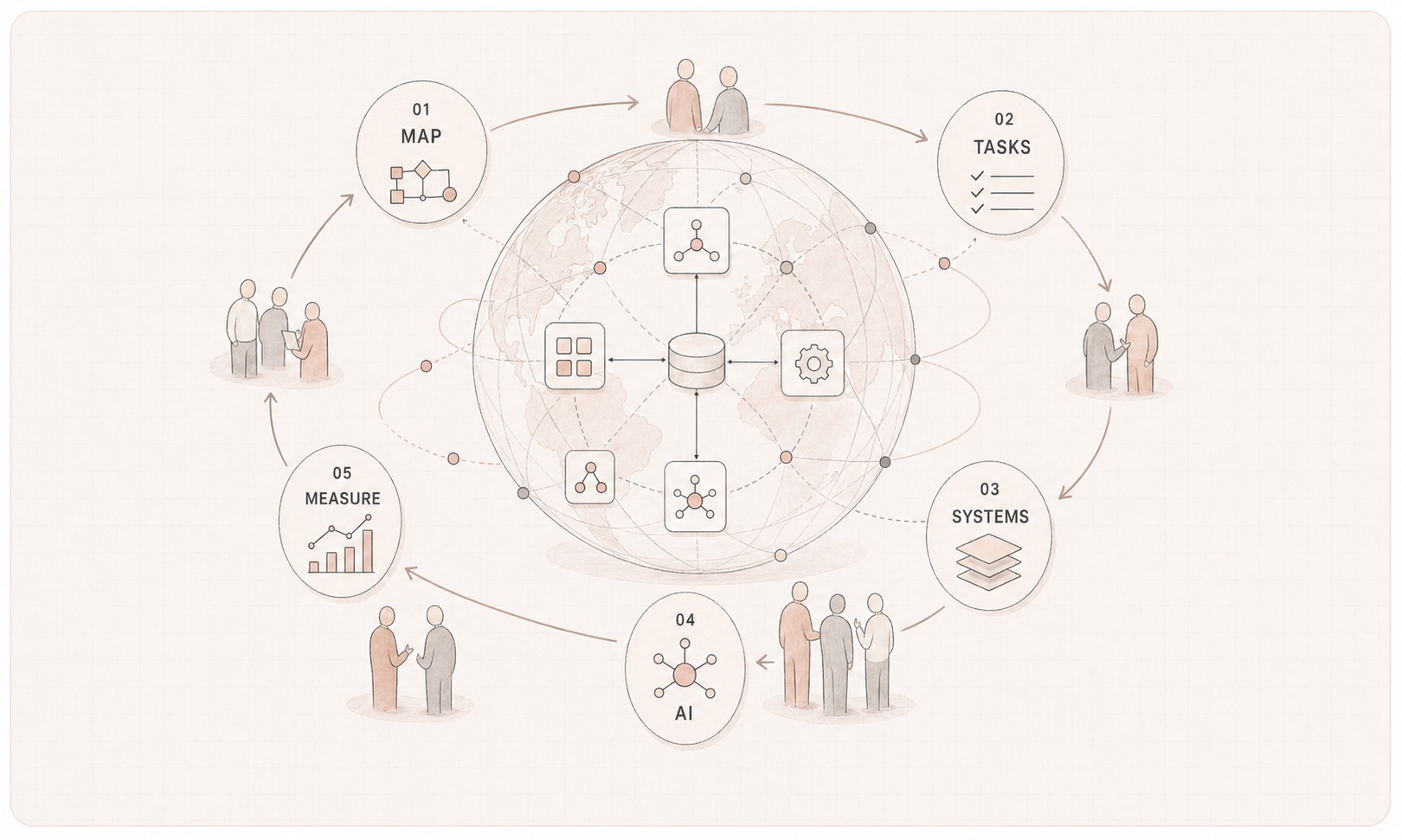
Step 1: Map Your Current Workflows
Document how work is currently performed across teams.
Focus on clarity:
- What triggers tasks
- What inputs are used
- What outputs are expected
Step 2: Identify Repetitive Tasks
Look for tasks that:
- Occur frequently
- Follow predictable patterns
- Require minimal judgment
These are strong candidates for automation.
Step 3: Structure Systems
Group tasks into workflows.
Define:
- Process steps
- Decision points
- Dependencies
This aligns with the “systems” layer of the Tasks to Systems to Agents framework.
Step 4: Introduce AI Gradually
Introduce AI where it adds value.
Examples:
- Automating reports
- Monitoring performance
- Generating drafts
Avoid automating everything at once.
Step 5: Monitor and Improve
Track performance continuously.
Refine:
- Inputs
- Outputs
- System design
AI systems improve through iteration.
Frequently Asked Questions
How long does AI implementation take?
It depends on process complexity, but initial improvements can happen quickly with structured workflows.
What should be automated first?
Repetitive, rule-based tasks.
Do you need technical teams?
Not always. Many improvements start with process clarity.
Next Step
Effective AI implementation begins with understanding your operations.
Continue reading
Back to InsightsMore Actionable Insights
AI Tools
Best AI Tools for Consultants and Growth Teams in 2026
A practical AI stack for consultants and growth teams that want better thinking, cleaner workflows, stronger content systems, and sharper visibility.
Enterprise AI Operations
How to Implement AI in Business Operations: The Tasks to Systems to Agents Framework
A practical framework for turning scattered AI experiments into structured operational systems that enterprise teams can trust, measure, and scale.
Enterprise AI Strategy
Why Most AI Projects Fail in Enterprises (And What to Fix First)
Why enterprise AI projects stall, what usually breaks first, and how to fix the operational structure before scaling automation.